
Boston Divorce Records
Boston divorce records are held at the Suffolk County Probate and Family Court in the Edward W. Brooke Courthouse on New Chardon Street. Residents of Boston who need to look up a past divorce case or get a copy of a judgment can search online or visit the court in person. The court keeps all divorce filings for Boston, Chelsea, Revere, and Winthrop. You can use the state's free case search tool to find basic case info from your home. For certified copies, you will need to contact the Register of Probate. This page covers how to find, request, and get divorce records if you live in Boston or had a case filed here.
Boston at a Glance
Boston Divorce Court Info
All Boston divorce records go through the Suffolk County Probate and Family Court. This is the sole court that handles divorce filings for the city. It sits in the Edward W. Brooke Courthouse near Government Center. The Register of Probate runs the clerk side and keeps all case files on site. Boston is one of the busiest courts in the state, with close to 12,000 new cases each year.
The court has a Virtual Registry that lets you get help from home. You can reach it by Zoom or phone during set hours. Staff can look up your case, help you file forms, and answer questions about your divorce records. This is a good option if you can't make it to the courthouse during the week.
| Court | Suffolk County Probate and Family Court |
|---|---|
| Address |
Edward W. Brooke Courthouse 24 New Chardon Street Boston, MA 02114 |
| Phone | (617) 788-8301 |
| Hours | Monday through Friday, 8:30 AM to 4:30 PM |
| Virtual Registry | 9:00 AM - 1:00 PM and 2:00 PM - 4:00 PM (via Zoom or phone) |
Note: There is no public parking at the courthouse, so plan to use MBTA stops at Haymarket, Bowdoin, or North Station.
Search Boston Divorce Records Online
You can search for Boston divorce records in a few ways. The fastest option is the Massachusetts Trial Court case search portal. Select "Probate and Family Court" as the court type, then pick "Suffolk County" from the list. Enter the last name and first name of one spouse. The system shows case numbers, filing dates, and case status. It is free to use and open to the public.
If you know the docket number, you can search by case number for an exact match. Make sure you type it with the right letters and spacing. Results show party names, docket entries, and whether the case is still open or closed. The online system covers records from about 2009 forward. Older cases may not show up.
For records that don't show online, visit the court at 24 New Chardon Street. Go to the third floor where the Register's Office handles record requests. Staff can look up any Boston divorce case by name or number. You can also use the Suffolk County Virtual Registry to get help from home without going to the courthouse.
Note: Online records are for reference only and may not have the most current case info.
Boston Divorce Records Resources
The Suffolk County Probate and Family Court page on Mass.gov has contact info, hours, and links to all court forms you may need for a Boston divorce case.
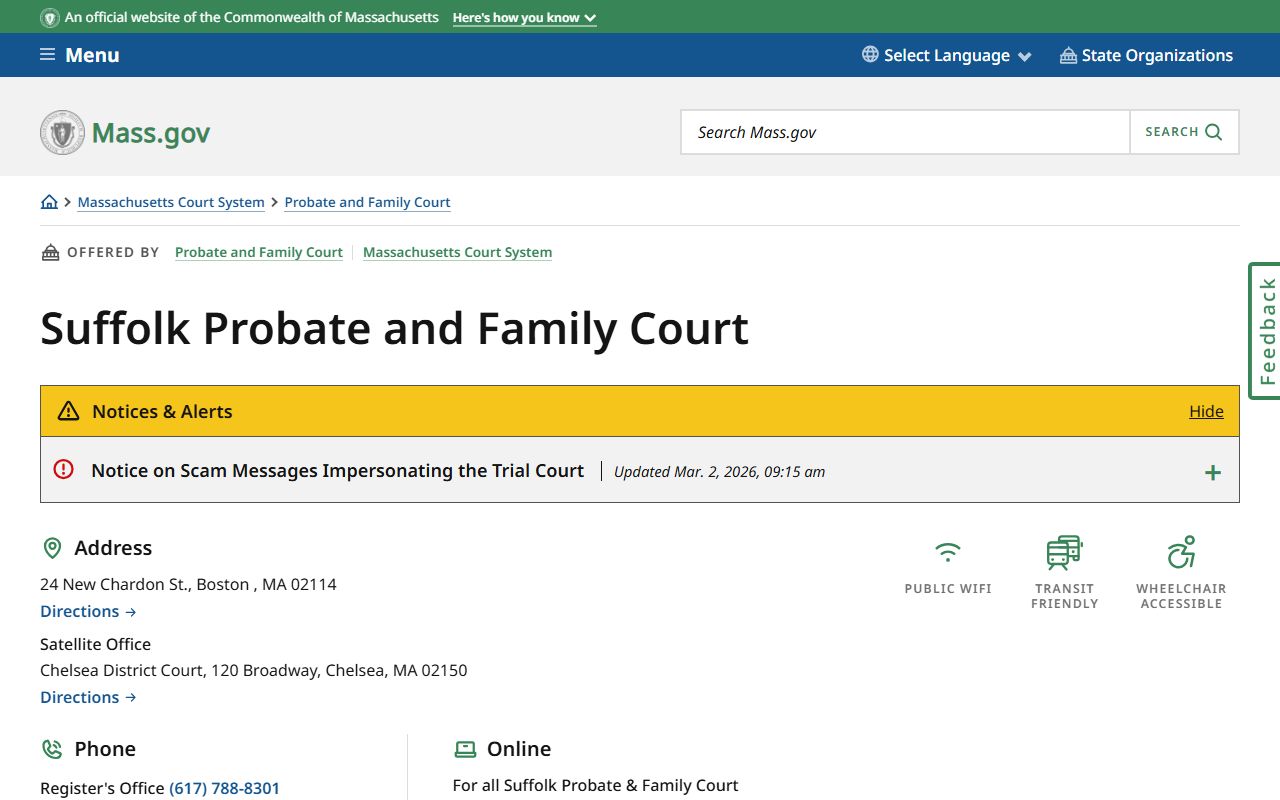
This site shows the court address, phone numbers, and a link to the Virtual Registry. You can also find the PFC 18 form here, which is the main form used to order copies of divorce documents.
The Virtual Registry page below shows how Boston residents can reach the court from home for divorce record help.
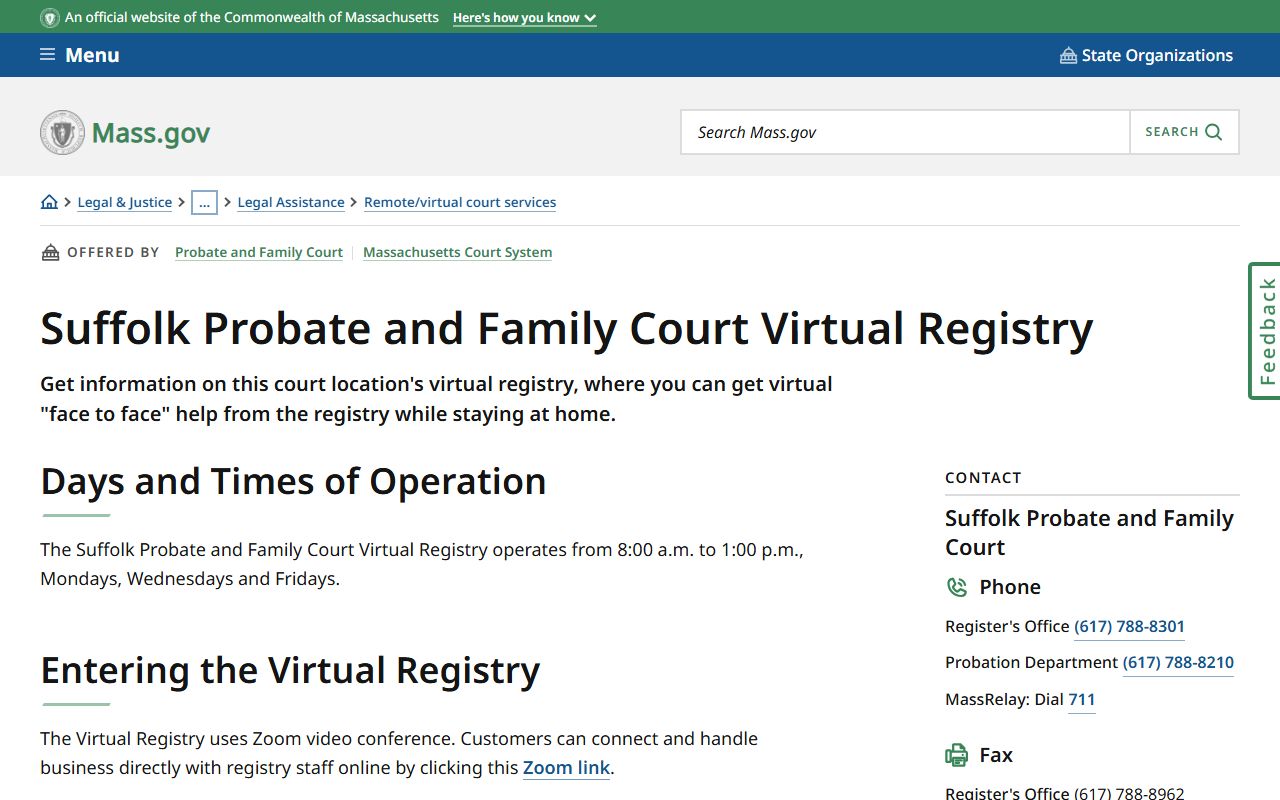
The Virtual Registry uses Zoom and phone calls. It is open most weekdays and can help with record look-ups, form questions, and case status checks.
Divorce Filing Fees in Boston
Filing fees for divorce in Boston follow the same schedule as all Massachusetts courts. A joint petition under M.G.L. c. 208, § 1A costs $215. A complaint filed by one spouse under § 1B costs $280. These fees go to the Suffolk County Probate and Family Court.
On top of the base fee, there is a $15 surcharge. A summons costs $5. Citations run $15. If you need the other spouse served by a constable or sheriff, expect to pay $50 to $75 more. The court takes cash, money orders, and bank checks. Personal checks are only for lawyers. Fee waivers are available if you have low income. File an Affidavit of Indigency and the judge will review it.
Copies of divorce records cost $20 each for a certified copy of the Certificate of Divorce Absolute or Judgment of Divorce Nisi. A certified copy of a separation agreement is $20 for the first page plus $0.05 for each page after that. Plain copies run $0.05 per page. You can see the full PFC 18 request form and fee list on the state court site.
Boston Divorce Filing Process
To file for divorce in Boston, at least one spouse must live in Massachusetts. Under M.G.L. c. 208, § 5, if the cause for divorce happened outside the state, the filing spouse must have lived here for at least one year. If the grounds arose in Massachusetts, there is no wait. You file at the Suffolk County court if either spouse lives in Boston, Chelsea, Revere, or Winthrop.
Most Boston divorces use the no-fault path. Under § 1A, both spouses file a joint petition with a signed separation agreement. The court holds a hearing within 30 days. After the judge enters a judgment nisi, you wait 120 days for it to become final. The whole process can wrap up in four to five months if both sides agree.
If one spouse files alone, they use the § 1B complaint. The other spouse gets served and has 20 days to respond. This path takes longer. After the hearing, the nisi period is 90 days. Fault-based grounds under M.G.L. c. 208, § 1 include adultery, desertion, and cruel treatment, but most cases today use the no-fault option.
Note: The divorce is not final until the nisi period ends, even if the judge signs the order at the hearing.
What Boston Divorce Records Show
A Boston divorce file has many parts. The complaint or joint petition starts the case. It lists the grounds for divorce, the names of both spouses, and what the person filing is asking for. If there are kids, the filing includes a parenting plan and child support worksheet. Financial statements show each side's income, debts, and assets.
The key document most people need is the judgment of divorce nisi. This court order lays out the terms: who gets what property, custody, the visit schedule, and any support. Under M.G.L. c. 208, § 34, the court looks at 15 factors when dividing assets, and those terms show up in the record. After the nisi period, the divorce becomes absolute. The Certificate of Divorce Absolute confirms the marriage has ended.
Most Boston divorce records are public. You do not need to be a party to request copies. Some items may be sealed, like info about children or abuse victims. Social Security numbers and bank account numbers are redacted from electronic records under Supreme Judicial Court Rule 1:24.
Legal Help for Divorce in Boston
Greater Boston Legal Services gives free legal help to people with low income in Boston. They handle family law cases like divorce, custody, and support. Call (617) 371-1234 to ask if you qualify. Their site at gbls.org has more details on what they cover.
The Suffolk County court runs a Lawyer for the Day program on Tuesdays and Wednesdays from 9 AM to noon. It is first-come, first-served. A lawyer can help you fill out forms and understand your options at no cost. The Court Service Center on the first floor also helps people who are filing without a lawyer. You can get step-by-step guides and all official forms free at mass.gov.
The Massachusetts Bar Association runs a lawyer referral line at (617) 654-0400. The first meeting costs $25 for a half hour. They also have a Dial-A-Lawyer program on the first Wednesday of each month. For self-help guides and how-to info, visit MassLegalHelp.org.
Nearby Cities
These cities are near Boston. If your divorce was filed in a different county, check the city where you lived at the time.